How I Automated a Finance Workflow Without Building an App
What happened when I turned a recurring financial analysis into a Claude skill, and what I'd tell anyone in finance trying the same
Almost everyone in finance has a workflow they repeat: the monthly variance review, the credit memo, the quarterly look at a company’s filings. And when people start thinking about automating it with AI, the first instinct is almost always the same: I should build an app.
I had that instinct too. I wanted a tool that reads a Philippine REIT’s report and answers one question in plain language: is the dividend backed by real cash, and what should an investor know? I didn’t build an app. I built a Claude skill instead, a folder of instructions, reference notes and small scripts that Claude loads whenever someone asks the right question. It reads a 66-page quarterly report or a 699-page annual report, does every calculation in code, and cites the page and exact words behind every number. I wrote almost none of the code. Claude did, over about two days, while I made the decisions.
I’ll write up a general method separately. This post is the field notes: what actually happened on one finance workflow, with the real numbers, the wrong turns, and the things the filings themselves got wrong. If you work in finance and you’ve been wondering whether you need developers, a budget and six months to automate an analysis, this is my answer: probably not, but you do need to know your analysis cold.
Why Not Just Build an App?
Because the app comes last, and it’s the part that teaches you the least. Before I committed, I compared three options:
- A skill uploaded to the Claude app. The friendliest option: users just ask questions. But it runs in a sandbox and doesn’t update itself.
- Claude Code, working in a folder of files. A real machine with full Python tooling, files that persist, and the option to run on a schedule. More technical, but it’s where the engine gets built and tested.
- A web app on top. Best for everyday investors, but it needs a working engine underneath first.
I chose Claude Code as the workshop and a skill as the product. The trick is that it isn’t either/or: the same skill folder runs in Claude Code, uploads to the Claude app as a zip, and can later sit underneath a web app. You build the engine once.
For most finance workflows, I’d make the same call. The hard part of financial analysis was never the user interface. It’s getting the numbers right, showing where they came from, and knowing when something looks off. A skill lets you solve exactly that, and test it, before you spend a peso on screens and buttons.
Start With the Analysis, Not the Software
The most important thing I did happened before any code existed: I did the analysis by hand, with Claude, in a regular chat. The skill captures a workflow I had already proven, not one I imagined.
It started broad. I asked Claude to brainstorm finance AI projects and, more usefully, to tell me what makes one credible. The answer became my rules: numbers computed in code, every claim cited to a page, accuracy measured against a hand-checked answer key, real messy documents, and an honest write-up of what fails. Then I narrowed the project to a single question an investor actually asks: is the dividend safe? Everything later had to serve that question.
Next I learned the domain. I gave Claude a standard guide to analyzing REITs and asked it to adapt the framework to the Philippines instead of copying it. That mattered: many PH REITs carry buildings at fair value, so the distortion is paper gains, not depreciation, and PH REITs report “distributable income” rather than the FFO metric US analysts use. When the explanations got too technical, I asked for a simpler one, and Claude explained it with a paupahan (a rental apartment): your accounting profit, plus back the paper charges, minus real upkeep, compared with what you pay yourself. That analogy later became the skill’s plain-language mode.
Then I uploaded a real filing, AREIT’s Q1 2026 quarterly report, and asked Claude to build the bridge from earnings to dividend:
| Step | ₱ millions |
|---|---|
| Net income | 2,559.7 |
| + Fair value loss (paper loss) | +63.7 |
| = FFO | 2,623.4 |
| − Straight-line rent (booked, not yet collected) | −63.7 |
| − Capex | −39.0 |
| = AFFO | 2,520.7 |
| Q1 dividend declared (₱0.62 × 3.72B shares) | 2,303.8 |
| Coverage | 1.09x |
The headline was simple: the dividend was covered, 1.09 times. But the interesting part came from cross-checking numbers within the filing. The rent adjustment equaled the fair value loss to the peso, while uncollected rent rose only about ₱41.1M. About 19% of revenue came from sponsor-related finance leases that the company itself listed as non-cash. And the REIT lent ₱794.9M to related parties in the quarter.
That one exercise shaped the whole design: one clear answer up front, then a few “worth knowing” flags. It also taught me that the value lives in the checks, not the chart. Those three flags became the first expected answers in my test set.
Writing Down the Analyst’s Job
Once the hand-done analysis worked, I stopped thinking about software and started thinking about my own job description. Everything an analyst does when reviewing a filing had to land somewhere specific in the skill:
| What the analyst does | Where it lives in the skill |
|---|---|
| Pulls numbers from the filing and notes the page | Claude, writing to a facts file: each value with its page and the exact words printed there |
| Builds the model: FFO, AFFO, coverage, NAV | Python scripts. Claude never does the arithmetic itself |
| Knows the accounting and the local rules | Reference notes: fair value vs cost model, the REIT law’s 90% payout rule, a catalog of red flags |
| Follows the house process and won’t cut corners | SKILL.md: the steps, plus five rules (numbers from scripts, cite every page, flag don’t guess, no buy/sell advice, plain language) |
| Writes the memo | A report template: one-sentence answer, a safety light, the flags, the bridge with sources |
| Gets reviewed by a senior | Checks that fail loudly, and a second Claude session that reviews against the filing |
The facts file in the middle is the part I’d insist on. It’s the equivalent of a clean data tab that every calculation links to: reading the PDF and doing the math become separate jobs, and each can be checked on its own.
A few practical things I checked early. Cost wasn’t the constraint: a quarterly report is roughly 30,000 tokens, so covering every REIT on the exchange for a year costs under a dollar with a small model. Messy documents were. Filings arrive as bundled PDFs with auditor letters and notary pages mixed in, and the annual report ran to 699 pages, mostly appraisal reports. So the skill indexes a filing page by page and reads only the pages it needs, about 7% of that annual report.
Letting Claude Build It
The build started with a starter kit Claude generated from our conversation: the SKILL.md, a workflow guide, four reference files, the facts schema, a metrics script and a test script. The decision that made everything else work was that the first test case came straight from the hand-done analysis. I saved the Q1 numbers as “gold” facts with page citations, plus the expected answer and flags. Before any PDF-reading code existed, the metrics script reproduced the full analysis from those facts and passed 15 of 15 checks. Then I fed it a wrong capex figure and a wrong page, just to make sure the test would notice. It did.
From there I moved to Claude Code on a GitHub repository, and every change followed the same loop:
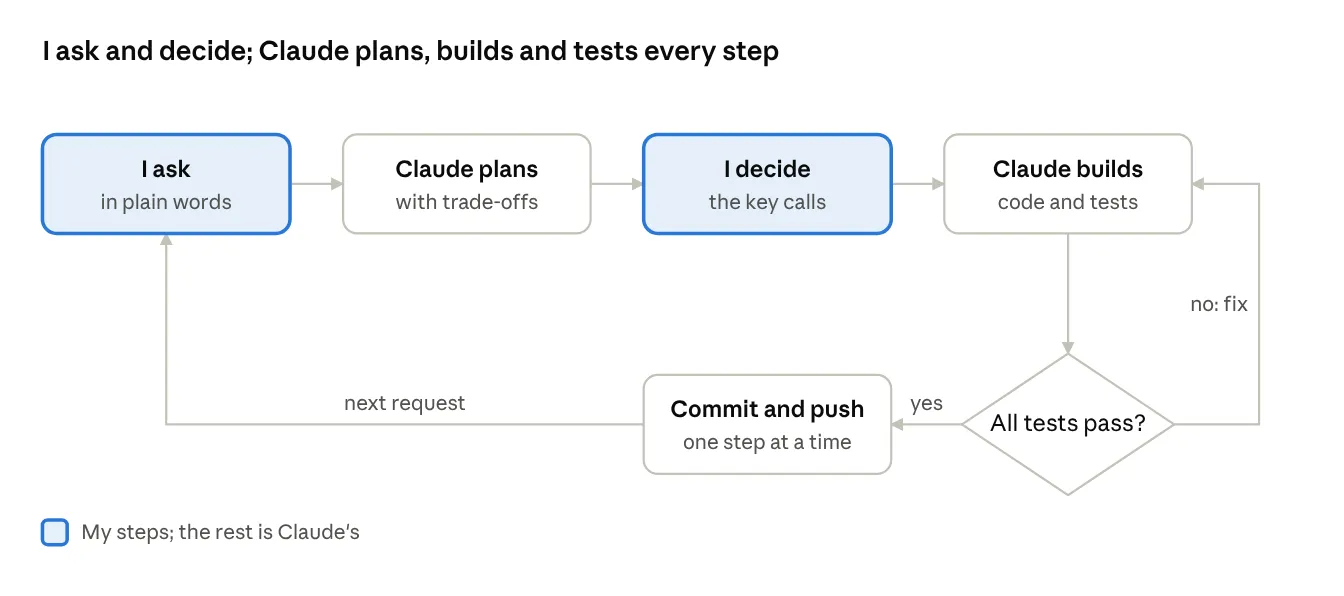
My requests were genuinely plain. Things like:
- “Check this repo against Anthropic’s guide to building skills and tell me what’s wrong.”
- “You combined the Q1 and Q2 dividends into one line. Show me how each was calculated, and quote a phrase I can search for in the PDF.”
- “This quarterly report only shows cash flows year-to-date. What’s the right way to review it?”
- “What’s missing for a REIT that uses the cost model instead of fair value?”
- “The annual report counts a building purchase as capex. Should that hit AFFO?”
That first request paid off immediately. The review found seven gaps, the worst being that the skill only worked inside my repository: its core rules lived in a project file that wouldn’t travel with it. That was a quick fix on day one and would have been a real headache later.
The second-opinion habit helped too. When Claude Code proposed something I wasn’t sure about, how to treat NAV for example, I took its answer to a separate Claude conversation, had that one critique it against the filing, and sent the refined instruction back.
What stayed human. Automation built everything, but it didn’t decide anything that shapes what an investor reads. Claude stopped and asked whenever a choice changed the method, and laid out the options with numbers. I decided how to handle quarterly reports that only show cash flows year-to-date. I decided NAV would stay secondary, and that the skill would never estimate a value the filing doesn’t state. I decided to exclude building purchases from capex only when the filing names them, which is the difference between a 2024 coverage of 1.06x and a misleading 0.87x. And I decided when it was ready to ship.
Checking Against the Source
The review loop paid off when I checked the six-month output against the actual filing. Each finding went back into the skill as a standing rule rather than a one-time fix:
- A flag that didn’t fire. The rent adjustment again equaled the fair value loss (₱214.2M), but no flag appeared. New rule: ask why a check didn’t fire, not only why one did.
- A quarter hiding in plain sight. Q2 alone could be derived as the half-year minus Q1: about 1.14x, against 1.12x for the half. New rule: derive the latest quarter when the earlier period’s figures exist, and say it’s derived.
- The share price was in the filing. I’d assumed it would have to come from outside. Page 27 had the quarter’s closing price (₱37.35) and the company’s own NAV per share (₱37.60). New rule: check the source before assuming.
- My “appraisal NAV” idea was weaker than I thought. The property table’s column turned out to mean something different, and two malls showed no value at all. New rule: don’t build a metric on a column whose meaning isn’t confirmed.
- A typo in the filing itself. One row of the share issuance table showed APIC of ₱4,162,137,233 when it should be about ₱3,219,410,793, though the column total was right. New rule: check every row, and label filing errors as the filing’s.
- News after the quarter ended. On August 10 the board approved a 462.5M-share swap and a ₱2.62B cash purchase, against ₱30.9M of cash at June 30. New rule: read the subsequent events note and surface anything affecting shares, debt or dividends.
Two lessons stood out. First, the reviewer can be wrong too: my own ideas about the share price and appraisal NAV didn’t survive contact with the document. Second, the most important news is often outside the financial statements, in a note about what happened after the quarter ended.
The automated checks kept catching things on their own as well. The citation checker, which opens the PDF and looks for each quoted phrase, found that 15 of 32 labels were descriptions rather than words you could search for. A cross-check against the company’s reported interest coverage (34.73x) caught a formula that didn’t match its definition. And the checks flagged real problems in the filings: a 2023 figure printed two different ways in the same annual report, a fair value gain labeled as a “loss,” and “QUARTERLY REPORT” on the cover of an annual report. I also planted two errors on purpose, a wrong sign and a dividend on the wrong share count. Both numbers really appear on the cited pages, so only the analysis checks could catch them. They did.
What It Does Now
Two days and 22 commits later, the skill is 16 files: one SKILL.md, six reference guides, a schema and seven Python scripts. No app, no server, no screens. On AREIT’s own filings:
- Full year 2025, from the 699-page annual report: dividend coverage 1.07x (green), payout of distributable income 91.05%, matching the company’s figure and above the 90% legal minimum. Book NAV of ₱36.57 per share, or ₱38.17 with leases at their disclosed fair value. 86 facts cited and checked against the PDF.
- First half 2026, from the 66-page quarterly report: coverage 1.12x for the half (green), with Q2 alone derived at about 1.14x. 104 facts cited and checked.
- Tests: six test cases (three real periods, three with planted errors) run 29 to 166 checks each, all passing. The page finder locates 41 of 41 target pages across both filings. The skill loaded for 14 of 14 relevant requests, including ones in Filipino and Taglish, and for 0 of 11 unrelated ones.
The honest caveat: so far all of this is on one REIT. Passing my own tests isn’t the same as working on a filing the skill has never seen.
Five Things the Filings Taught Me
None of these were AI problems. They’re the same traps that catch a junior analyst, and they’re exactly what a skill has to be told about:
- Quarterly cash flows are year-to-date. The income statement shows the quarter; the cash flow statement doesn’t. Mix the two and every coverage ratio is quietly wrong. I chose a year-to-date review, with the latest quarter derived only when it can be checked against the filing.
- Share counts move mid-period. AREIT issued 441.1M shares during the half, so each dividend had to use its own record-date share count. One count for the whole period looks fine and isn’t.
- Labels lie; statements don’t. The annual report’s dividend section calls a fair value gain a “loss.” The skill now takes signs from the audited income statement only.
- Filings disagree with themselves. 2023 distributable income appears as ₱4,931,289,156 on one page and ₱4,844,725,435 on another. The skill uses the audited figure and reports the other as a likely filing inconsistency, citing both pages.
- The annual report is mostly not the annual report. Of 699 pages, the numbers come from about 30; the rest is appraisals, sponsor reports and scanned pages. Index first, read only what you need.
If You Work in Finance
From this build, the ones worth turning into a skill share four traits:
- Document-heavy. The work starts from a filing, statement, contract or report, not from a blank page.
- Rule-based at its core. There’s a formula, a policy or a regulation that defines the right answer, even if applying it takes judgment.
- Checkable. Every number can be traced back to a page, so a script can confirm it.
- Recurring. Monthly, quarterly, per deal. If you do it once a year, a good chat is enough.
For my own skill, what’s next is mostly about earning trust: verifying the answer keys myself, running it on a REIT it has never seen in a fresh session, finding a REIT that uses cost accounting so that code path meets a real filing, and packaging the skill folder so it’s easy to download. A daily monitor for new filings and a simple mobile front end can wait. They’re the app part, and the engine had to come first.
I started this project wanting an app. I still don’t have one, and so far I don’t miss it. What I have is an analysis I trust (at least partially), because it shows its sources, fails loudly when something doesn’t add up, and runs the same way on the hundredth filing as on the first. The screens can come later.
The skill is public. Feel free to explore the repo and test it yourself: point it at a REIT filing it has never seen, and tell me where it breaks.
Thoughts, questions and corrections are very welcome. Email me or find me on LinkedIn.
For learning and research only. There may be mistakes. Not investment advice.