Learning JEV by trying to fit it into what I already knew
I didn't learn JEV by reading a definition. I learned it by trying to fit it into everything I already knew about AI, and paying attention to where each comparison broke.
This note is less about explaining what JEV is and more about how I came to understand it.
When I first encountered it, I kept trying to place it inside the mental models I already had: LLMs, predictive models, and eventually AI workflows. Each comparison helped, but none of them quite fit, and the places where they broke were probably more useful than the comparisons themselves.
The simplest mental model I ended up with is this:
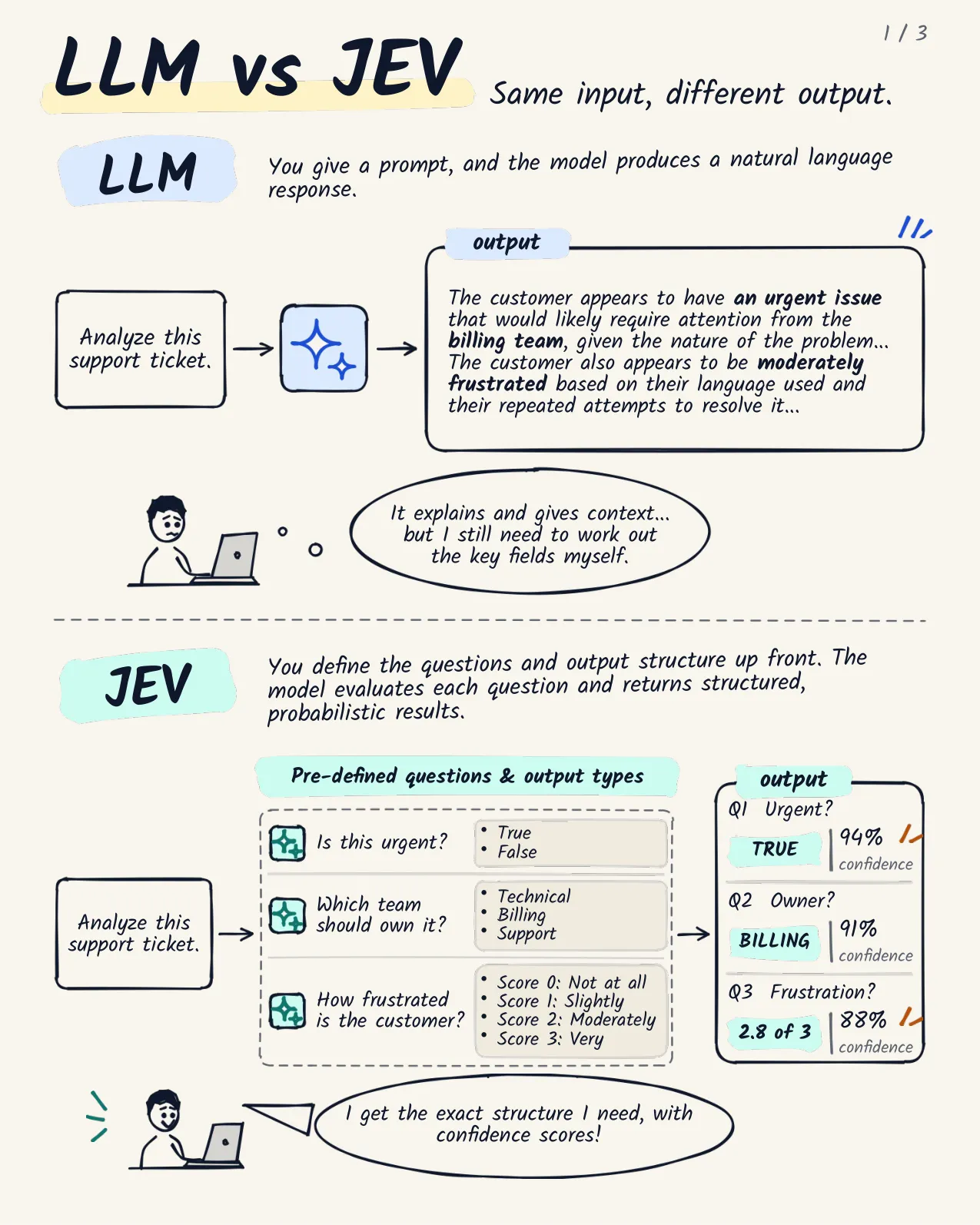
An LLM gives you flexible, natural-language output. JEV lets you define the questions and output structure up front, then returns structured, confidence-aware results.
That distinction became more interesting when I started thinking about what happens after the model produces those results.
A note on where I am: I’m still early. JEV is new, and much of the material I found came from its creator, TypeSafe. So this is a learner’s note, not a review or a claim that I fully understand where JEV will ultimately fit.
The question I started with
My starting question was pretty simple:
If an LLM can already classify, score, and reason over messy information, what does JEV actually add?
I didn’t want to start with a use case. I wanted to understand the underlying idea first, so I started with the comparison I already knew: give an LLM some messy context and ask it to analyze it.
The LLM is good at explaining what it sees. But if I need an application to reliably work with the result, I still have to figure out the important fields myself.
With JEV, the questions and output types are defined first. Instead of asking the model to generally “analyze this,” I can ask specific questions such as:
- Is this urgent?
- Which team should own it?
- How frustrated is the customer?
The result is structured around those decisions, with outputs such as TRUE, BILLING, or a frustration score and associated confidence.
Four stages of figuring it out
Looking back, I was learning JEV mostly by comparing it with things I already understood. That happened in four stages.
1. I anchored it to what I already knew
My first mental model was:
LLM = flexible generation
JEV = structured decision-making
That seemed straightforward. If I gave an LLM a support ticket and asked it to analyze the ticket, I would get a useful explanation of the problem, its urgency, the likely owner, and the customer’s frustration. But I would still need to extract those things from the response.
With JEV, I define the decisions first:
- Is this urgent? True or false
- Which team should own it? Technical, billing or support
- How frustrated is the customer? A score from 0 to 3
The important difference wasn’t simply that the output was structured. It was that I had defined what I wanted the model to decide before it ran, and that became the foundation for everything else I was trying to understand.
2. I tried to break every explanation
“Structured decision-making” sounded right, but I didn’t trust the phrase yet.
JEV gives you confidence values, but plenty of traditional predictive models give you probabilities too. A Random Forest, for example, can tell you that something has a 73% probability of belonging to a particular class. So what is actually different?
That question forced me to separate two things that initially looked similar. A traditional predictive model usually has a predefined target and a known set of features, so the decision problem is largely established when the model is trained. JEV, at least as I understood it, starts from a different place. You define the questions, the possible outputs, and the context for the decision, and the model then evaluates those questions and returns structured results.
That doesn’t make it a replacement for predictive models. It just means I was putting two things into the same mental bucket when they probably belong in different parts of the toolbox.
3. I needed to see real output
At some point, thinking about it wasn’t enough, and I wanted to see what actually came back.
So I tried JEV on a messy incident scenario and asked it a set of predefined questions. Instead of one long answer, I got a collection of structured decisions:
| Decision | Probability / confidence |
|---|---|
| Human attention needed | 96% |
| Integration issue | 92% |
| Revenue impacted | 87% |
| Partner launch endangered | 87% |
| Security concern | 76% |
| Credible churn risk | 71% |
There were categorical and scored outputs as well.
This was probably the point where the idea clicked for me. The output wasn’t really the answer. It was a collection of machine-readable signals about specific decisions I’d already decided mattered, and that made me think about what could happen with those signals next.
4. I kept moving one layer down
Once I understood the output, my next question became:
Okay, but what happens after JEV decides?
That pulled me away from thinking about JEV as a standalone model and toward thinking about it as one component in a larger application:
Context → JEV → Structured decisions → Business logic → Workflow → LLM or human
In that setup:
- JEV can evaluate predefined questions and produce structured signals.
- Business logic can decide what should happen based on those signals.
- An LLM can explain or summarize the result.
- A human can make the final judgment.
That was more interesting to me than the original question of “JEV or LLM?” The better question became:
What should each component be responsible for?
A concrete example: journal entry review
I wanted to map the idea onto something I actually understood, so I used journal entry review. The basic flow became:
- Input: journal entry, supporting documents, accounting policy, and entity/account context.
- JEV: evaluate predefined questions such as:
- Is the supporting documentation complete?
- Does it comply with accounting policy?
- Is manual review required?
- What is the risk level?
- Business logic: if the risk is high or manual review is required:
- Route to an exception queue
- Flag for accountant review
- Prepare a review summary
- LLM: turn those structured signals into something a person can actually read and understand.
- Human: review the signals, read the explanation, consider the business context, and decide what happens next.
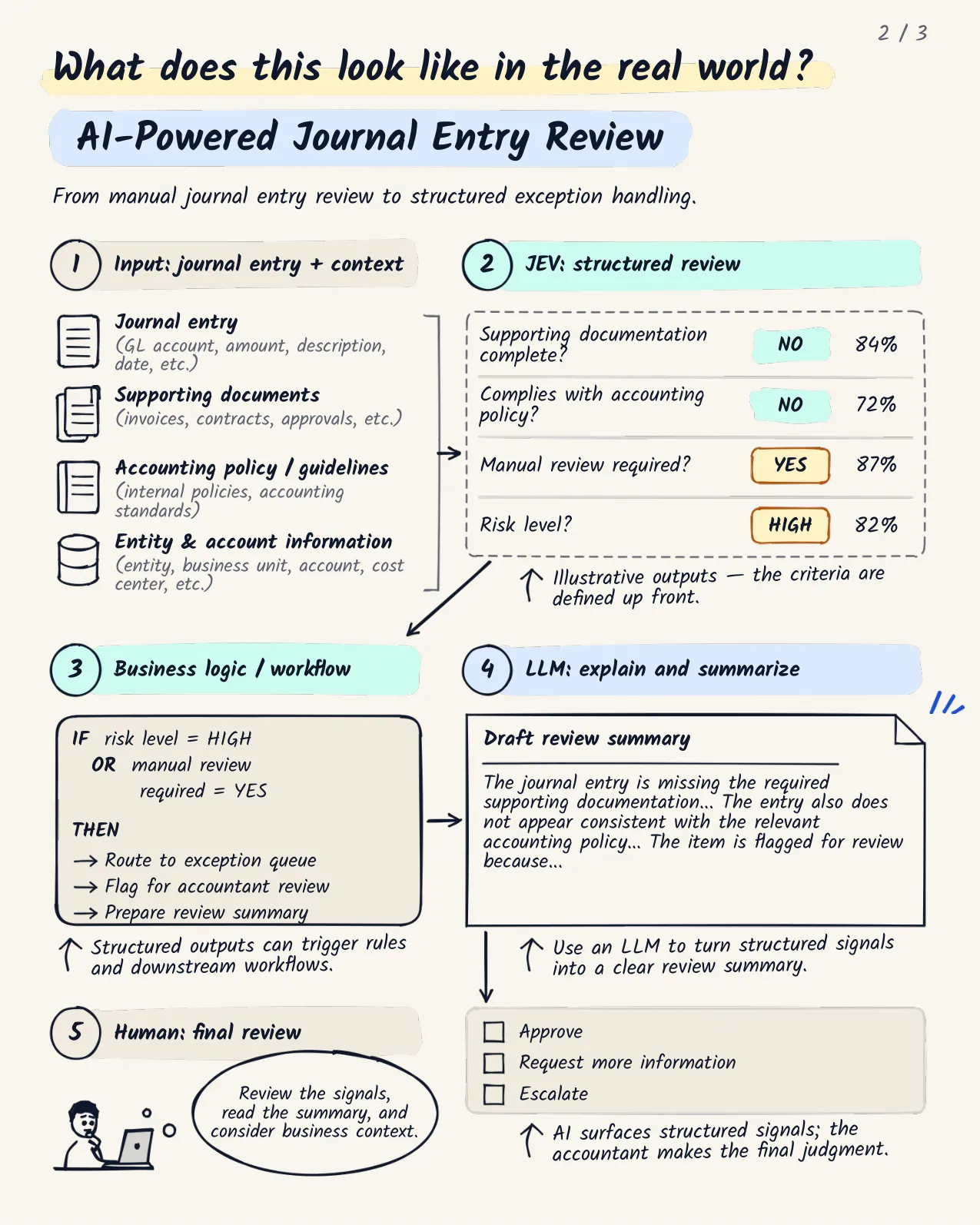
I like this example because it makes the division of responsibilities much clearer. The AI isn’t trying to replace the accountant. It’s surfacing structured signals that can make the accountant’s review more targeted.
What I learned
The biggest thing I learned wasn’t actually about JEV. It was about how I learn unfamiliar technology.
I kept trying to map JEV onto things I already understood: LLMs, predictive models, Random Forests, workflows, and eventually agents. Each comparison was slightly wrong, but instead of being a problem, that was what helped me understand the thing I was comparing.
So my takeaway for learning any unfamiliar AI system is to ask where it fits into the mental model you already have, and then pay attention to where that model breaks.
The second thing I noticed is that explaining something is a surprisingly good test of whether I actually understand it. Some of my initial explanations sounded reasonable in my head, but once I tried to put them into a diagram or explain them simply, I noticed the gaps. The visuals I made for this note helped with that too. The first page is a side-by-side comparison of the same input going through an LLM versus JEV, while the second turns the idea into a journal entry workflow.
I’m still early here. I don’t think there’s enough evidence for me to make strong claims about how broadly JEV will be useful or where it will ultimately fit. The current material itself presents a fairly specific model: bounded, structured, confidence-aware decision tasks, compared with the flexibility of an LLM. So I don’t want to pretend I have the final answer.
What I do have is a mental model that makes more sense to me now:
LLMs are flexible, but less bounded. JEV is bounded and structured.
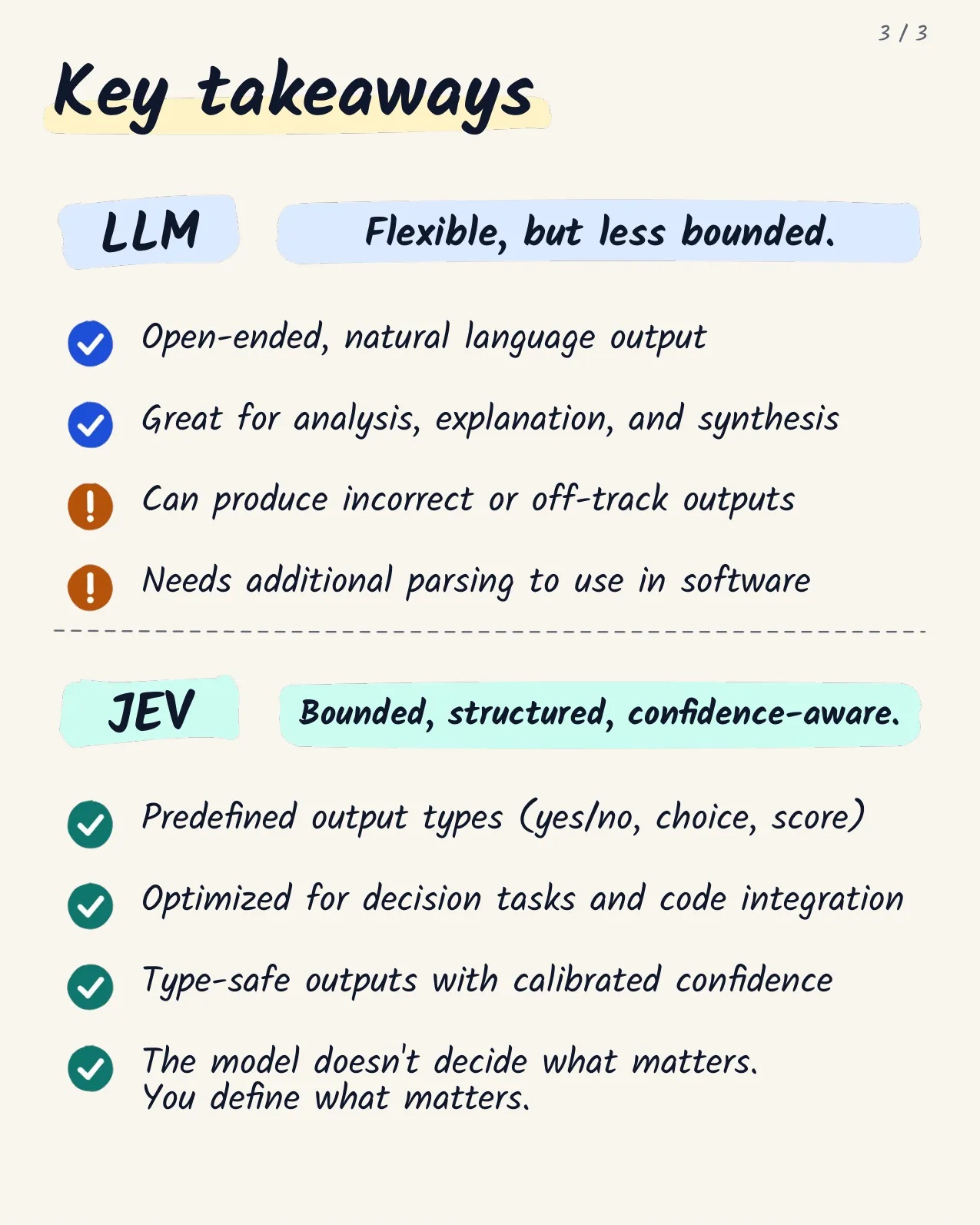
And maybe that’s the more interesting direction for AI applications: not one model trying to do everything, but different components doing different jobs.
That’s the part I want to keep exploring.
Artifacts
- LLM vs JEVThe three visuals from this note in one file. Same input through an LLM and through JEV, the journal entry review workflow, and the key takeaways.